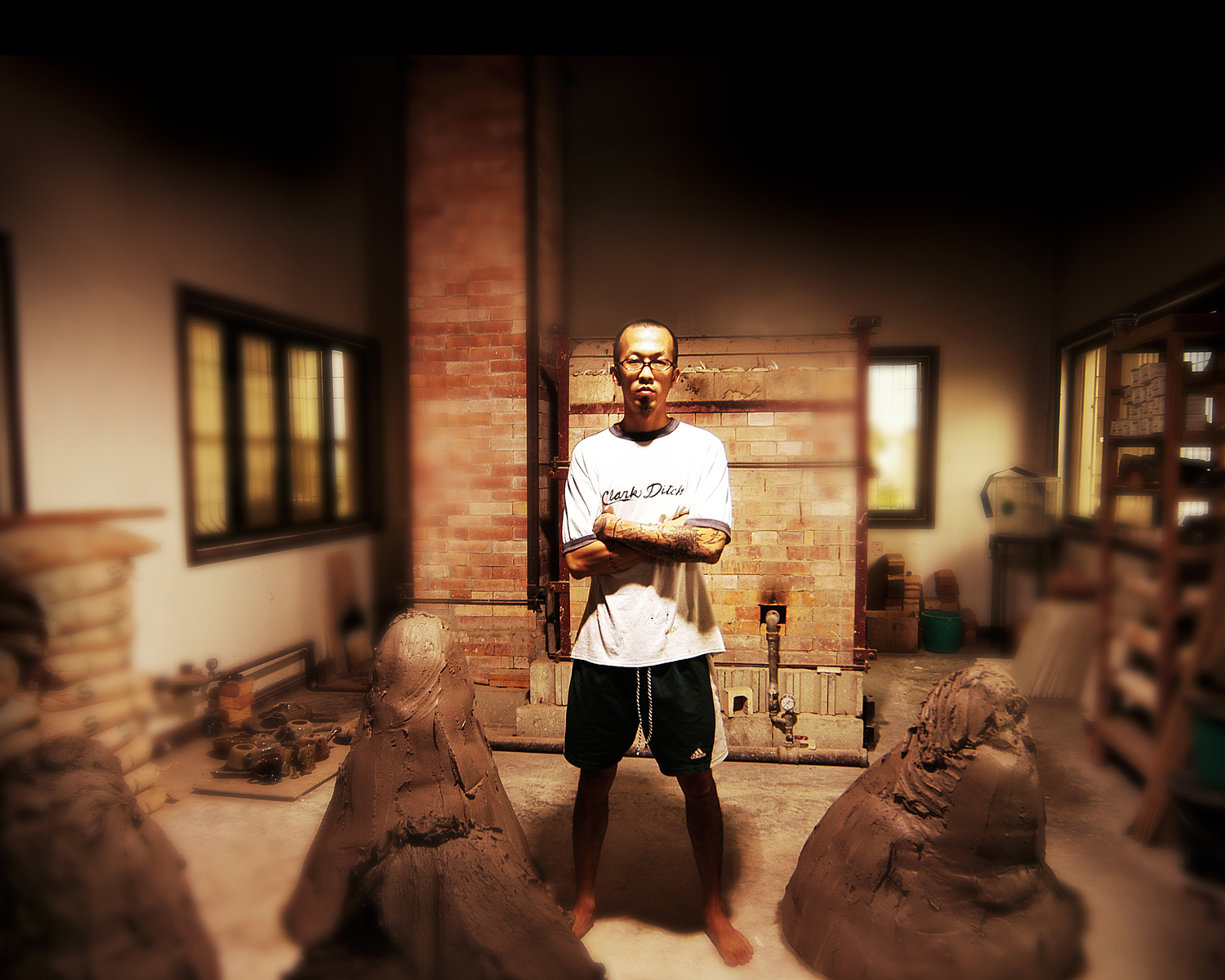
ceramic artist
Hadrian Mendoza, a stoneware Potter, works with a fearless and audacious search for unusual and indigenous forms, including expressionistic and abstract shapes. Mendoza was a graduate at Mary Washington College in Virginia and a former student at the Corcoran School of Art in Washington DC, where he was awarded the prestigious Anne and Arnold Abramson award for Excellence in Ceramics in 1996-1997. In 2015 he was one of 5 ceramic artists commissioned by Kholer Co. to represent Southeast Asia in a travelling exhibit titled “Bold. Art. Asia.” In 2017 he received his MFA at The George Washington University where he was also awarded the Alfred E. Steck Memorial Prize for Sculpture.
His curatorial journey began when he organized the 1st Southeast Asian Ceramics Festival under the 2007-2009 Toyota Foundation Japan Grant. He curated the 2nd Southeast Asian Ceramics Conference and Exhibition in Fuping Pottery Art Village’s FLICAM International Ceramics Museum in China. In 2012 with the Asian Cultural Council Humanities Fellowship Grant he curated “Earth and Fire” at The Workhouse Arts Center in Virginia. And in 2016 he curated “The Tree of Life Ceramics Festival at The Ayala Museum with a grant provided by The Ayala Foundation.
In 1997 he searched for his roots and moved back to the Philippines, where he slowly metamorphosed into an individualistic and nationalistic artist with a keen and hungry eye for Southeast Asia’s indigenous forms. He has made deliberate attempts at achieving heavy cultural undertones for his works. In 2009, Hadrian moved to Virginia, USA with his family and is currently a lecturer at The Catholic University of America and is head of the visual arts department at St. Anselm’s Abbey School, both located in Washington DC. A humble craftsman, Mendoza serves at the feet of his own cultural dilemmas as an artist.
His works are permanent collections in museums and institutions in Washington DC, Cambodia, China, Korea, Japan, Thailand, Turkey, and 3 renowned museums in the Philippines, which are The Metropolitan Museum Manila, The Ayala Museum, and BenCab Museum.